The workspace layer for AI agent infrastructure
Aetherfs gives every agent an isolated workspace without cloning the repo. Copy-on-write sessions share a common base, start in under a second, and cost a fraction of a VM.
Join Private Beta
Speed
<10s
Session startup vs. 3–5 min for VM clone
Storage
<1%
Storage overhead for typical edits vs. 100% duplications
Concurrency
1,000+
Concurrent isolated sessions per host, rather than dozens.
Savings
5x
Infrastructure cost reduction by eliminating idle VM waste
The Problem
Your agents are waiting on infra, not writing code.
Traditional agent platforms use one VM per agent, even though over 70% of VM time is idle during planning, editing, and review. Each clone-and-setup cycle takes 3-5 minutes per session, and costs grow linearly with the number of agents.
Cut Your Infra Costs
VM-Based Inefficiency
Every session boots an OS, clones the full repo, and reinstalls dependencies. The previous session did the same thing 30 seconds ago.
Developer-Agent Friction
Agents and developers work in different environments with no shared state. Handing off work means repackaging artifacts. There's no way for a human to review what an agent just did.
Cost Inefficiency
Most of your cloud spend goes to idle compute. Agents can't share dependencies or artifacts, so every session duplicates the same work. At $0.50/hr per agent, it adds up fast.
Complex Session Management
Forking is expensive, checkpointing doesn't exist, and rollback is manual. Fan out 50 agents on the same codebase and you get 50 full clones.
How aetherFS Solves It
Replace per-agent VMs with a shared foundation.
Every session is a lightweight, in-memory overlay that records only the differences from a shared, immutable base repository. File contents are stored once in a deduplicated object store shared across all sessions.
Copy-on-Write Sessions
Sessions start from a shared base in milliseconds. Forking is a metadata operation, not a full clone. A 312 MB repo forks at less than 1% of the original size.
Zero Duplicate Storage
The deduplicating object store normalizes all file content across sessions by hash. Storage scales with the size of your changes, not the number of agents. 90%+ deduplication in practice.
Session ID Handoff
One session ID works across HTTP, gRPC, and local FUSE mounts. Backend creates, agent mutates, human reviews. No images, no tarballs, no repackaging.
Built-in Review Gates
Checkpoints, approvals, and annotations are first-class objects. Agents request human sign-off before committing. Reviewers inspect and approve without leaving the session. No separate PR workflow.
Performance Benchmarks
Measured, not marketed
Real-world session fork benchmark on a 312 MB repository. All operations served from the shared object store — no network I/O required.
Without aetherFS
With aetherFS
3-5 min
<10s
Session created from shared base
312 MB per agent
Full workspace copy every time
2.8 MB
<1% of repo size for typical edits
$0.50/hr per agent
70%+ idle waste included
$0.10/hr per agent
<10% idle waste, 5x cost reduction
10-20 per host
Concurrent agents before infra limits
1,000+ per host
50x density on same shared base
Handoff between agent and reviewer
Pass session ID
Same workspace, instant handoff
The Platform
Four pillars of efficiency and scale.
AetherFS replaces the wasteful VM-per-agent model with a unified substrate built on proven, battle-tested patterns from Dropbox, Google Drive, Bazel, and Elastic Block Storage.
Pillar 01
Copy-on-Write Overlays
Instant speed, minimal storage
Every session is a lightweight overlay that only records differences from a shared, immutable base. File contents are stored once in a hash-indexed object store with an LRU cache and bounded memory. Forking is a near-zero-cost metadata operation.
Pillar 02
Unified Control Plane
Collaboration and governance
A central Session Manager persists all metadata, checkpoints, and tags. Coordination services provide a message bus for real-time events, pessimistic locks for critical sections, and formal approval workflows. All events flow through a single, auditable log of record.
Pillar 03
Decoupled Compute
Eliminate idle spend
A ProcessService and pool of containerized workers execute commands on-demand. Jobs dispatch via a durable queue, run in isolated containers with resource limits, and stream results back. 95%+ of an agent's lifecycle spent planning or editing generates near-zero compute spend.
Pillar 04
Dual Access Model
Maximum adoption, zero rewrite
Sessions are accessible as a mounted local directory via FUSE/WebDAV (no agent rewrite required — even npm install works), or programmatically through a rich gRPC/HTTP API for reading files, submitting changes, and subscribing to events.
Access Surfaces
HTTP
JSON‑first integration for backends and workflow engines, with RESTful endpoints exposed via an Axum-based gateway.
gRPC
Streaming, binary-optimized, auto-generated clients, powered by twelve core services: FileSystem, Session, Persistence, MessageBus, Collaboration, Oversight, and more.
AetherFS CLI / FUSE
Network-backed storage that feels local, with sub-1 ms cache hits, intelligent prefetching, and write-back optimization. Expose it as a local mount for editors, shells, and builds.
Architecture Overview
Layered overlay filesystem, built in Rust.
System Layers
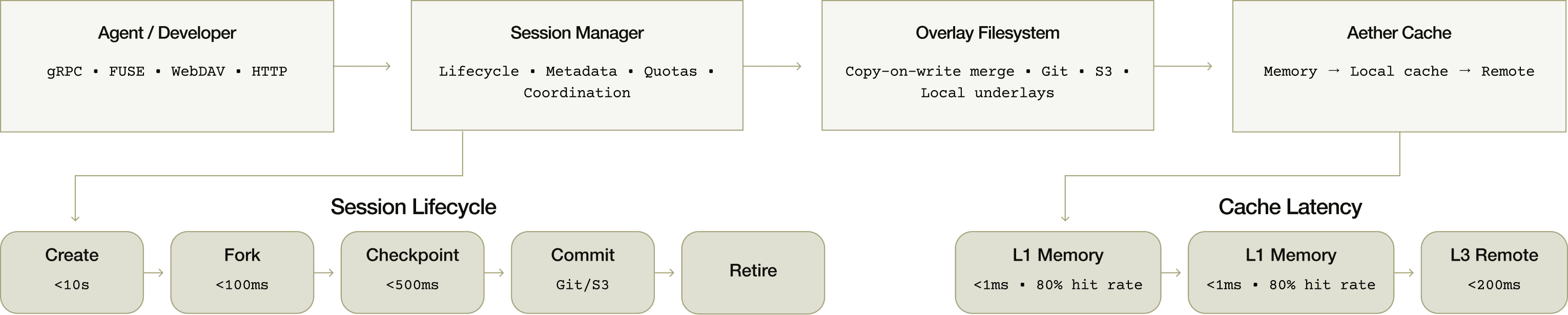
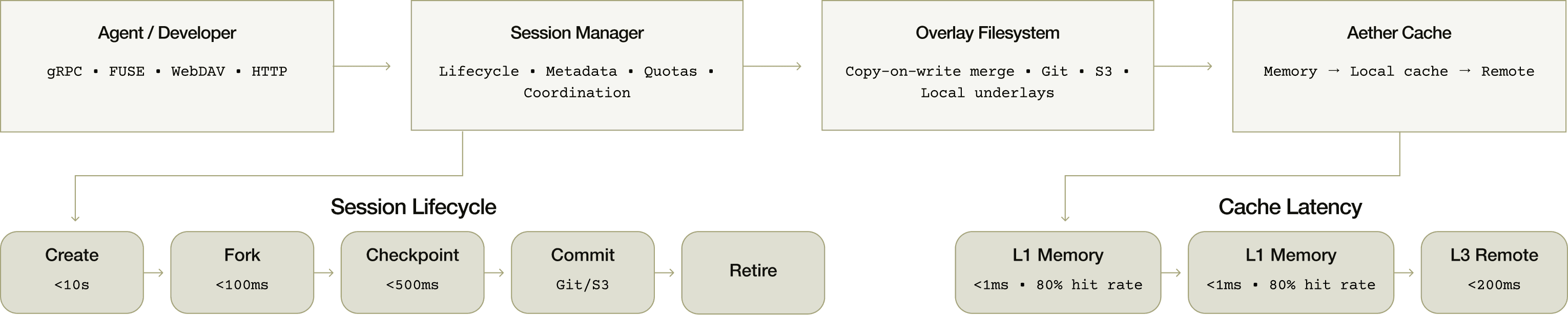
Agent or developer requests are sent via gRPC, FUSE, WebDAV, or HTTP to the Session Manager, which forwards them to the overlay filesystem. The overlay combines a writable in‑RAM layer with a read‑only underlay (Git, S3, local, or empty). Beneath the overlay, the Content‑Addressable Store manages deduplication and reference counting, with support from the aetherFS multi‑level cache.